
Update: 6 September 2026
Important note: The measures in this article are announcements from the Prime Minister’s speech at the Thessaloniki International Fair on 5 September 2026. Apart from the rent refund for teachers, doctors and nurses, which already has a Joint Ministerial Decision, all of them still need legislation. The speech gave no date for a bill. Amounts, thresholds and dates may change when the Ministry of National Economy and Finance publishes the details.
On 5 September 2026 Kyriakos Mitsotakis presented a package of measures at the Thessaloniki International Fair (ΔΕΘ) costing €2.2 billion in 2027 and €3.5 billion in total by 2030. He called it the “Agreement for Progress and Prosperity”. Most measures do not start now. The bulk applies from 2027, and the €1,000 minimum wage is a target for January 2028.
This article collects what was announced, who it affects and when it starts, based on the official transcript of the speech. Where the numbers allow, it also shows what they mean in euros, using the logic of the gross-to-net calculator.
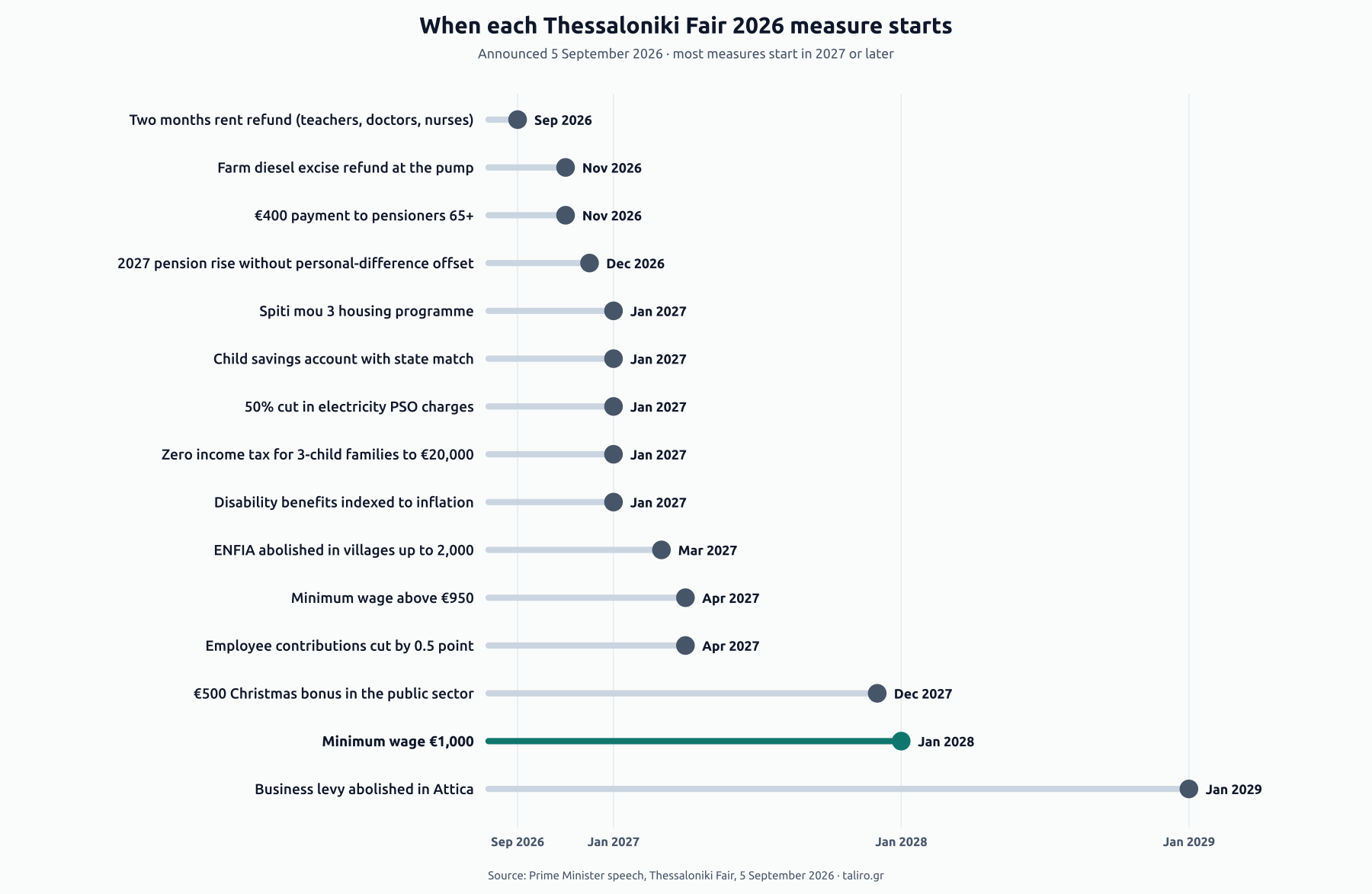
The timeline at a glance
| When | What starts | Who it affects |
|---|---|---|
| 25 September 2026 | Two months’ rent refunded, retroactively for 2024 | Teachers, doctors and nurses serving outside Athens and Thessaloniki |
| 1 November 2026 | Farm diesel excise refunded at the pump | Professional farmers |
| 30 November 2026 | €400 net payment, every November | Pensioners 65+, people with disabilities, uninsured elderly |
| Late December 2026 | 2027 pension increase paid without personal-difference offset (already law) | Pensioners with a personal difference |
| 1 January 2027 | Spiti mou 3, child savings account, 50% cut in PSO electricity charges, zero tax for three-child families, indexation of disability benefits | Home buyers, parents, households, three-child families, people with disabilities |
| 2027 tax returns (2026 income) | Zero tax for farmers to €20,000, lower presumptive income, business levy abolished outside Attica | Farmers, freelancers, companies |
| March 2027 | ENFIA abolished in settlements up to 2,000 residents | Owners in small settlements |
| 1 April 2027 | Minimum wage above €950, employee contributions cut by 0.5 point | Private-sector employees, indirectly the public sector |
| December 2027 | €500 gross Christmas bonus | Public servants |
| Tax year 2027 (2028 returns) | Income tax prepayment cut from 55% to 50% | Freelancers |
| January 2028 | Minimum wage €1,000 (target) | Private-sector employees |
| 2028 | Business levy in Attica halved, corporate tax prepayment starts falling | Companies |
| 2029 | Business levy abolished in Attica, target of 30% lower electricity price | Companies, households |
Private-sector employees
The minimum wage is currently €920 gross per month, since 1 April 2026. According to the speech, it will exceed €950 on 1 April 2027, and the target for January 2028 is €1,000. The €1,000 figure was stated as a target, not as a legislated amount. According to the Ministry of Labour, the minimum wage directly affects about 700,000 private-sector jobs. Law 5163/2024 provides that from 2028 the minimum wage will be adjusted by an automatic mechanism based on inflation and wage trends.
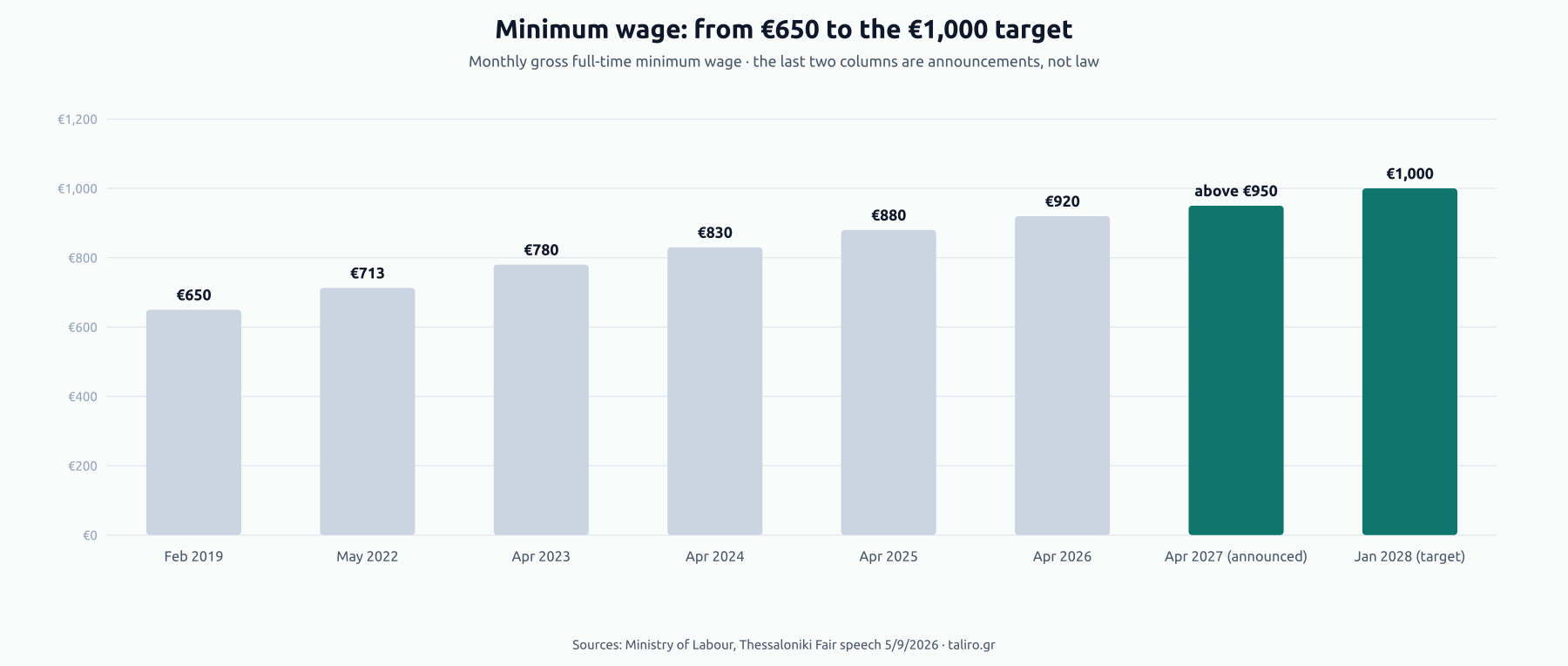
What a €1,000 minimum wage means in net pay
The calculation below uses the logic of the gross-to-net calculator, with 14 salaries, no children, age over 30, the 2026 tax scale and today’s contribution rates.
| Today, €920 | 2028 target, €1,000 | |
|---|---|---|
| Employee EFKA contributions (13.37%) | €123.00 | €133.70 |
| Monthly tax withholding | €23.69 | €37.55 |
| Net per month | €773.31 | €828.75 |
| Net per year (14 salaries) | €10,826 | €11,603 |
The difference is about €55 net per month, or €776 per year. If the contribution cut is also in place by then, net pay will be slightly higher than the table shows.
The 0.5-point contribution cut
From 1 April 2027 social security contributions fall by half a percentage point. Today the total is 35.16% of gross pay: the employee pays 13.37% and the employer 21.79%. The speech did not say whether the cut applies to the employee share, the employer share or both. The previous cut, one point from 1 January 2025, was split equally. Press reports before the fair said the new cut would come from the employer health contribution. If it falls on the employer, net pay does not change. The table below shows the scenario where the whole cut applies to the employee, from 13.37% to 12.87%.
The gain in the pocket is smaller than the contribution saving, because lower contributions mean higher taxable income. Part of the saving is taxed.
| Gross per month | Lower EFKA contributions | Net gain per month | Net gain per year (14 salaries) |
|---|---|---|---|
| €920 | €4.60 | €3.68 | €51.52 |
| €1,000 | €5.00 | €4.00 | €56.00 |
| €1,500 | €7.50 | €6.00 | €84.00 |
| €2,000 | €10.00 | €7.40 | €103.60 |
| €3,000 | €15.00 | €9.90 | €138.60 |
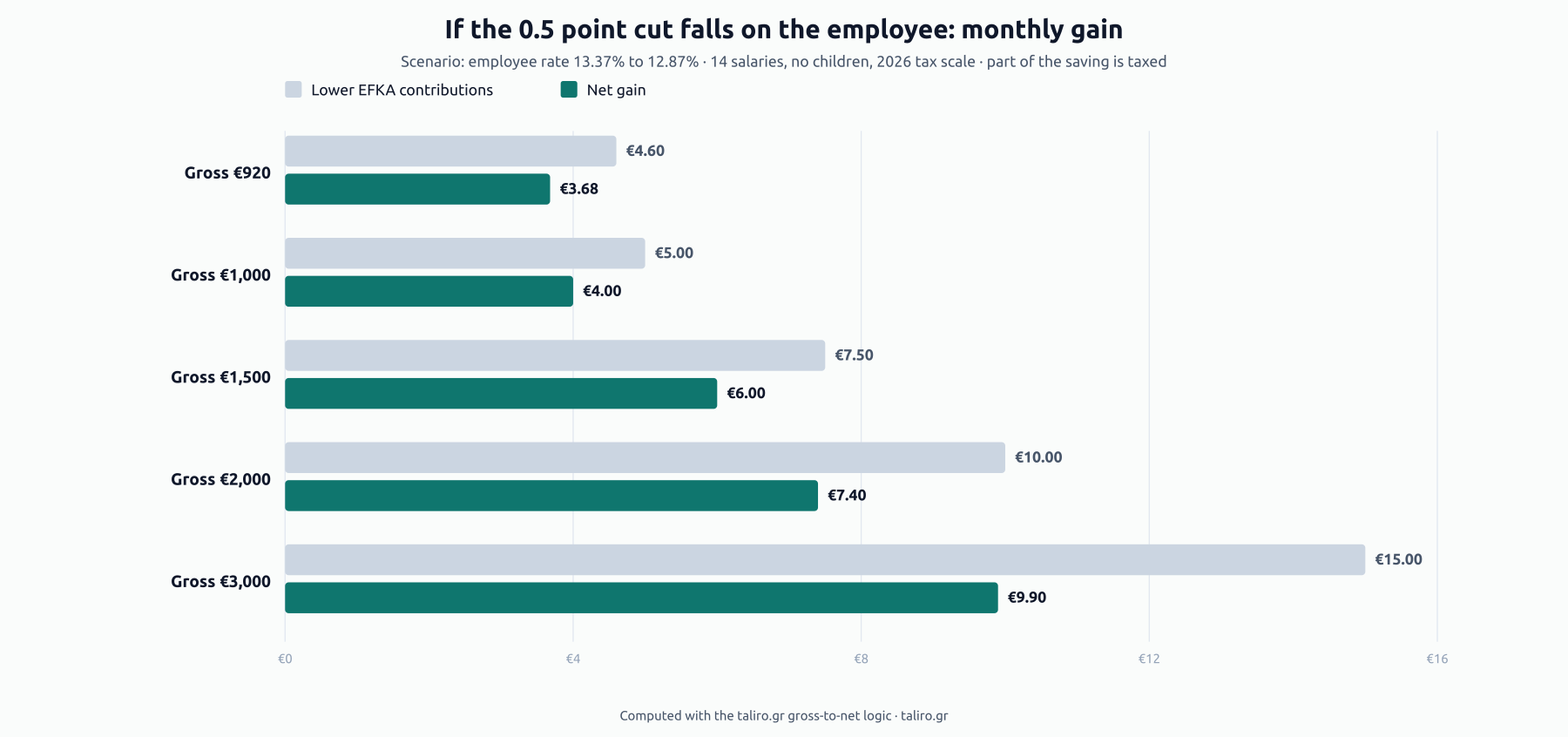
The figures are for an employee with no children, over 30, on 14 salaries and the 2026 tax scale. For your own case, the gross-to-net calculator accepts a custom contribution rate.
Public servants
A permanent €500 gross Christmas bonus is introduced for 720,000 public servants, first paid in December 2027. According to the speech, the amount will also count towards pensionable pay. Christmas, Easter and leave bonuses in the public sector were abolished from 1 January 2013 by Law 4093/2012. The new bonus is the first to return since then.
Public-sector pay is already linked to the minimum wage. Law 5163/2024 raises basic public salaries every April by the amount of the minimum-wage increase. In April 2026 that was €40. According to the speech, the minimum-wage rise on 1 April 2027 will bring an across-the-board increase in pay, allowances and seniority increments. Press reports put the total increases at up to €80 gross per month by January 2028. The exact amount per grade has not been announced.
Pensioners
The annual November payment becomes €400 net. In November 2025, €250 was paid to about 1.4 million recipients, with income limits of €14,000 for a single person and €26,000 for a couple. Law 5313/2026, passed in June, had already raised the November 2026 amount to €300 and the limits to €25,000 and €35,000, with about 1.87 million recipients. The speech raised the amount to €400 and spoke of 2.2 million recipients. First payment on 30 November 2026, then every November. Recipients include people with disabilities on OPEKA benefits and uninsured elderly people.
One point needs care. The speech described the payment as going to “everyone over 65”. Press reports citing government sources say the limits of Law 5313/2026 remain: income up to €25,000 for a single person and €35,000 for a couple, property up to €300,000 or €400,000 in tax value, age 65 completed during 2025, and widows or widowers from 60. If so, “everyone” means everyone within those limits. The exact terms will be set in the implementing decision.
The 2027 pension increases will be paid in late December 2026 without being offset against the personal difference. This is already law (article 265 of Law 5259/2025) and the speech repeated it. In 2025 the increase was fully offset against the personal difference, and in 2026 by half. From 2027 the roughly 670,000 pensioners who still have a personal difference will see the whole increase in the amount they receive. Press estimates put the increase at around 2.6% to 2.8%. The final rate will be set from 2026 inflation and GDP. For an estimate of your future pension, see the EFKA pension calculator.
Families with children
Three-child families: zero tax up to €20,000
From 1 January 2027 income tax is zeroed for parents of three children with income up to €20,000. It covers about 87,000 families. Because it applies to 2027 income, it will show in the 2028 tax returns. Today, under the 2026 tax scale, three-child families pay 9% on the first two brackets, up to €1,800 of tax before the tax reduction. According to calculations by Naftemporiki, the saving at €20,000 of income is about €620 a year.
Birth allowance for large families
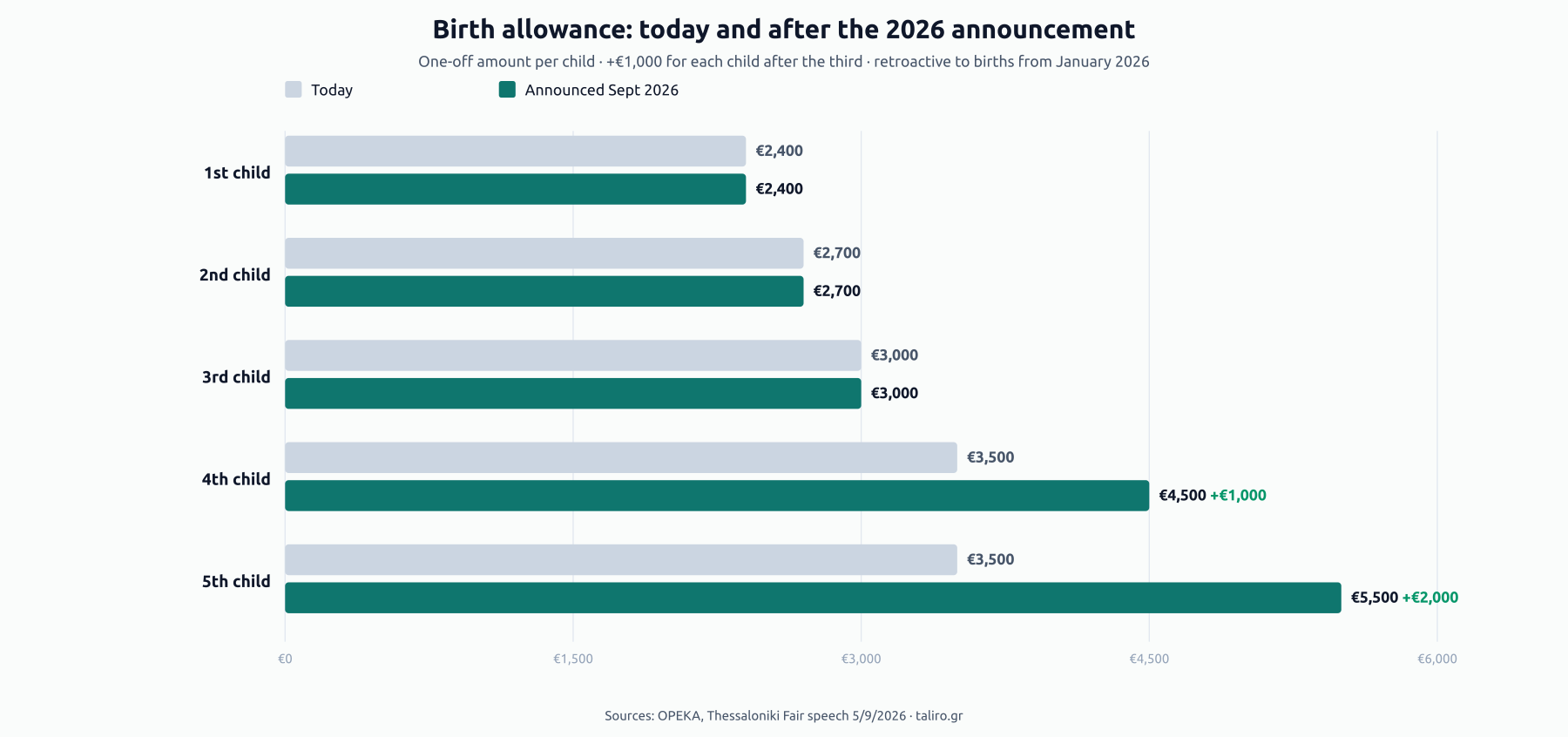
The birth allowance rises by €1,000 for each child after the third. For the fourth child the amount goes from €3,500 to €4,500, and for the fifth to €5,500. The Prime Minister asked for it to apply retroactively to births from January 2026. The amounts for the first, second and third child do not change. The allowance is paid by OPEKA in two equal instalments, with an equivalent family income limit of €40,000 a year.
Savings account for the new generation
From 1 January 2027 parents will be able to open a special account within the first two years after a child’s birth. The state will deposit the same amount as the parent, up to €1,200 a year. The money stays locked until the child turns 18.
A simple example: if the parents save €100 a month, that is €1,200 a year, the state adds another €1,200. Over 18 years the deposits reach €43,200, before any returns. According to press reports, the €1,200 cap will rise by 10% every five years. It has not been announced who will manage the funds, how returns will be taxed or on what terms withdrawals at 18 will be made.
Professional farmers
Income tax is zeroed for professional farmers with income up to €20,000. The measure applies to 2026 income, so to the 2027 tax returns, and according to the government covers about 50,000 farmers at a cost of €87 million. Today farm income is taxed on the employee scale. In the government’s example, a farmer with €20,000 of income pays about €1,183 of tax, which goes to zero.
From 1 November 2026 the excise duty on farm diesel, €0.41 per litre, will be deducted at the pump, at the time of purchase, through a myDATA QR code. Today the amount is refunded afterwards by the tax authority (AADE) in instalments, based on invoices and per-crop litre limits.
Freelancers and the self-employed
The presumptive minimum income for freelancers currently starts from the annual minimum wage (14 salaries, so €12,880 for 2026), rises with years in business, and is increased by 10% of staff payroll (up to €15,000) and by 5% of turnover above the sector average. For “compliant” professionals these two surcharges, on turnover and on payroll, are abolished. The 50% reduction of the presumption, which today applies in settlements of up to 1,500 residents, is extended to settlements below 2,000 permanent residents, or 2,200 in Western Macedonia. The changes apply to 2026 income and will show in the 2027 returns. According to the government, more than 155,000 professionals benefit at a cost of €170 million. The definition of a “compliant” professional has not been announced.
Income tax prepayment for individuals with business income falls from 55% to 50%, from tax year 2027. It will show in the 2028 tax assessments.
For anyone weighing salaried work against invoicing as a contractor, the employee vs B2B calculator shows the difference in net income.
Companies
The business levy for legal entities headquartered or with branches outside Attica is abolished from 2027, at a cost of €82 million. In Attica it is halved in 2028 and fully abolished in 2029. Today legal entities pay €800 a year, or €1,000 in cities above 200,000 residents, plus €600 per branch. For individuals the levy was abolished from tax year 2024.
Corporate income tax prepayment will fall from 2028 by 5 points a year, from 80% towards 50%.
Also announced: depreciation periods shortened from ten to six years, a 15% tax on profit distributions to board members and senior executives above €60,000 (from 5% today), and €1.5 billion moved from the Recovery Fund to the Hellenic Development Bank for loans and guarantees to small and medium-sized businesses.
Housing and property
Spiti mou 3
A new “Spiti mou 3” programme worth €2 billion, starting in early January 2027 through the Hellenic Development Bank. The aim is to bring the total number of young people who bought a home through the Spiti mou programmes to 40,000, from about 25,000 today. Spiti mou 2 closed in August 2026 with 15,097 approved loans worth €1.82 billion, 94.5% of its budget. The Prime Minister said the aim is for the age criteria to cover people up to 50. Income limits and loan terms have not been published. For what the previous programme offered, see the article on Spiti mou 2. To compare buying and renting, use the rent vs buy calculator.
ENFIA in small settlements
The abolition of the ENFIA property tax is extended to settlements of up to 2,000 residents, or 2,200 in Western Macedonia, from the March 2027 assessment. 131 settlements are added and the total reaches 12,855. According to the speech, the measure covers 650,000 owners. The extension builds on the existing measure in Law 5246/2025 for settlements of up to 1,500 residents (1,700 in border areas): a 50% reduction in 2026 and full exemption from 2027, for the primary residence only, with a tax value of up to €400,000, outside the Attica Region except for its islands. These conditions were not restated in the speech, so until further notice they are assumed to carry over to the new settlements.
Transfer tax for buyers from outside the EU
Property transfer tax is currently 3% of the tax value or the contract price, whichever is higher, plus a 3% municipal surcharge on the tax. It rises to 15% when the buyer comes from a country outside the European Union. For a €300,000 home the main tax goes from €9,000 to €45,000. The speech gave no start date. Press reports place it on 1 January 2027. It is not yet clear how dual nationals or permanent residents of Greece from third countries will be treated.
Rent refund for teachers, doctors and nurses
On 25 September 2026 two months’ rent will be paid to teachers, doctors and nurses serving outside Athens and Thessaloniki, retroactively for 2024. Further payments follow on 30 November 2026 for 2025 rents and on 30 November 2027 for 2026 rents. The measure is already law (article 4 of Law 5313/2026) and has a Joint Ministerial Decision. It covers about 50,000 people in public schools and public health units outside the Attica Region, except for its islands, and outside the Thessaloniki Regional Unit. The refund is 2/12 of the annual rent, capped at €1,600 plus €100 per child, with no income criteria. The general rent refund for all tenants continues every November, with income limits widened by the same law.
Electricity
From January 2027 the PSO charges (ΥΚΩ, public service obligations) on all residential electricity bills are halved. The cut applies only to this line of the bill, not to the total. The base charge falls from €6.90 to €3.45 per MWh, that is from €0.0069 to €0.00345 per kWh, for consumption up to 1,600 kWh per four-month period. Above that threshold the PSO charges are €0.05 and €0.085 per kWh. For a household using 4,000 kWh a year that stays within the first tier, the saving is about €14 a year before VAT. Recipients of the Social Residential Tariff are already exempt from PSO charges within their consumption limits. The electricity bill calculator breaks down what you pay on each line.
Separately, a target was set to cut the price of electricity by 30% over the next three years, by 2029. Press reports clarify that the target refers to the wholesale price. The average wholesale price was €103.6 per MWh in 2025. The plan from the Ministry of Environment and Energy is expected on 8 September 2026.
People with disabilities
From 1 January 2027 disability benefits are indexed on a permanent basis, meaning they are adjusted every year instead of staying flat. The last increase was 8% in May 2023. The severe disability benefit, for example, has been €338 a month since then. According to the speech, indexation covers 220,000 people with an average annual benefit of €220. People with disabilities are also among the recipients of the €400 November payment.
What it costs and how it is financed
The package costs €2.2 billion in 2027, about 1% of GDP, and €3.5 billion in total by 2030. For the 2027 filing season (returns on 2026 income) the Ministry counts €884 million of reductions. The largest lines:
| Measure | Cost in 2027 |
|---|---|
| Income tax cuts for professionals and farmers | €402 million |
| Lower presumptive income | €170 million |
| Keeping the 25% intermediate rate on rental income | €90 million |
| Zero tax for farmers up to €20,000 | €87 million |
| Business levy abolished outside Attica | €82 million |
| Exemption for foundations and bequests | €43 million |
| Survivor pensions excluded from the dependent-child limit | €10 million |
On financing, the Prime Minister said the government is “moving within the limits of the existing fiscal space” and that revenue from curbing tax evasion through electronic transactions makes the package possible. The 2026 primary surplus is estimated at around 4% of GDP.
What to keep in mind
- Most dates are in 2027. Within 2026 only the regional rent refund, the €400 for pensioners, the farm diesel refund and the pension increases without offset start.
- The €1,000 minimum wage is a target for January 2028. The next confirmed step is above €950 in April 2027.
- The contribution cut is worth €4 to €10 net per month for most salaries, if it applies to the employee share. It has not been clarified whether it falls on the employee or the employer.
- For the pensioners’ €400, wait for the exact terms. The speech said “everyone over 65”, the press reports widened limits.
- The tax measures for farmers, professionals and companies outside Attica will show in the 2027 returns. The zero tax for three-child families and the lower prepayment will show in the 2028 returns.
- None of the above is law yet, except the rent refund for teachers, doctors and nurses.
Sources
- Prime Minister’s speech at the 90th Thessaloniki International Fair, 5 September 2026 (primeminister.gr, in Greek)
- ERT: The implementation timeline of the Thessaloniki Fair announcements (in Greek)
- ERT: The 12 most important measures announced by the Prime Minister (in Greek)
- Reuters: Greek PM unveils plan to boost incomes
- Ministry of Labour: New minimum wage increase to €920, 26 March 2026 (in Greek)
- Law 5313/2026 (Government Gazette A 102/25-6-2026): €300 payment and rent refund for teachers and health workers (in Greek)
- Law 5246/2025, article 10: ENFIA exemption in small settlements (in Greek)
- Naftemporiki: Three-child families, zero tax up to €20,000 (in Greek)
- Ethnos: The €400 payment, when it is paid and who misses out (in Greek)
- Workenter: Personal difference, who gets the full increase from 2027 (in Greek)
- Capital.gr: The Joint Ministerial Decision on the double rent refund for teachers and health workers (in Greek)
- Capital.gr: New 0.5-point cut in employer contributions agreed, July 2026 (in Greek)
- Vradini: PSO charges cut by 50% from 2027 (in Greek)
- Dnews: Transfer tax for third-country nationals raised from 3% to 15% (in Greek)
- ot.gr: Spiti mou 2, more than 14,000 households bought a home (in Greek)
- Newsit: All the measures and the cost per measure (in Greek)
Reviewed on 6 September 2026. This information is general guidance, not personal tax advice.