
Updated: May 2026
Greece consistently ranks among Europe’s top countries for gambling participation. In just the first eight months of 2023, bets worth €22.7 billion were placed, with players losing approximately €1.7 billion during that period. On an annual basis, player losses reached €2.879 billion in 2024, up from €2.34 billion in 2022.
This article examines the financial figures of the gambling industry in Greece, player retention practices used by companies, and the mathematics that determine losses. To calculate your own expected losses, use the gambling expected loss calculator.
Greece as Europe’s Gambling Champion
Key market figures
Player losses in Greece reached €2.879 billion in 2024, up steadily from €2.34 billion in 2022 and €2.59 billion in 2023. That corresponds to about 1.2% of GDP and an average of ~€324 per adult per year.
| Indicator | 2022 | 2023 | 2024 |
|---|---|---|---|
| Player losses | €2.34 billion | €2.59 billion | €2.879 billion |
| Losses per adult | ~€265 | €291 | ~€324 |
| % of GDP | ~1.1% | ~1.2% | ~1.2% |
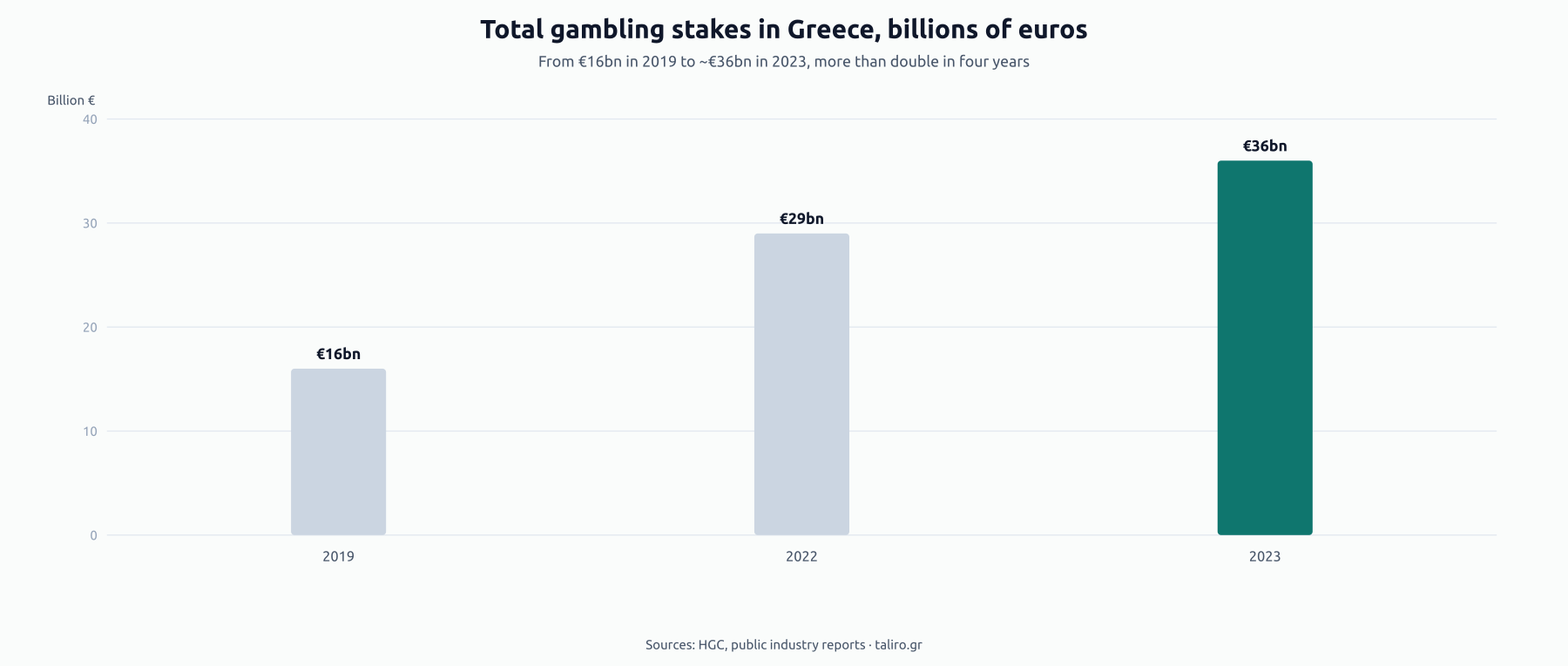
The volume of money wagered grew in parallel, from €16 billion in 2019 to roughly €36 billion in 2023, with most of those stakes returning to players as winnings and being rebet. In 2024 roughly 50% of losses came from retail venues and €1.066 billion came from online play, while state revenue from gambling taxes and participation rights reached €1.026 billion.
The illegal market
Alongside the legal market there is an illegal one that is hard to measure. Estimates for 2024 and 2025 range from ~€1.67 billion up to roughly the same size as the legal market. What is easier to quantify is enforcement pressure: the blacklist of illegal sites grew from 9,590 in 2024 to 12,642 in 2025.
The Gambling Industry
Financial performance of the sector
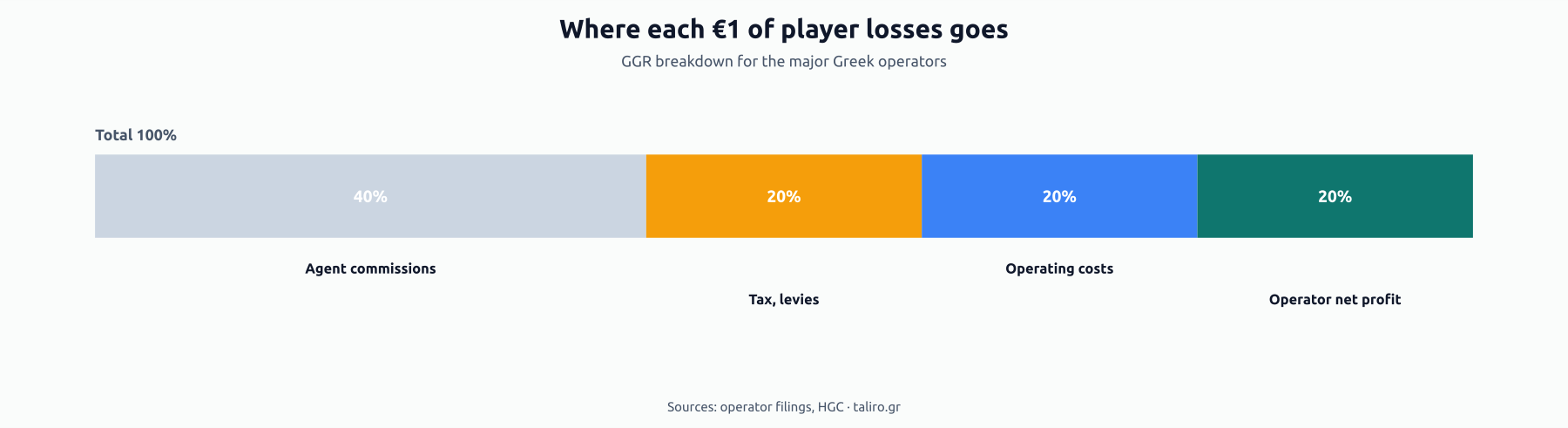
Major gambling providers in Greece show impressive profitability. The largest provider recorded gross revenues of €2.09 billion in 2023 with net profits of ~€400 million. Net profit margins in the industry hover around 20% of player losses.
| Where does every €1 lost by player go | Percentage | Amount |
|---|---|---|
| Agent commissions | ~40% | €0.40 |
| Taxes and fees | ~20% | €0.20 |
| Operating costs | ~20% | €0.20 |
| Provider net profit | ~20% | €0.20 |
Major providers are often described as “cash generation machines” with EBITDA margins of ~35%.
Retail network
Greece has over 3,500 retail gambling points of sale across the country - more than gas stations or bank branches. The average betting agency takes in roughly €1,700 per day in player losses.
The Mathematics of Losing
Return to Player (RTP)
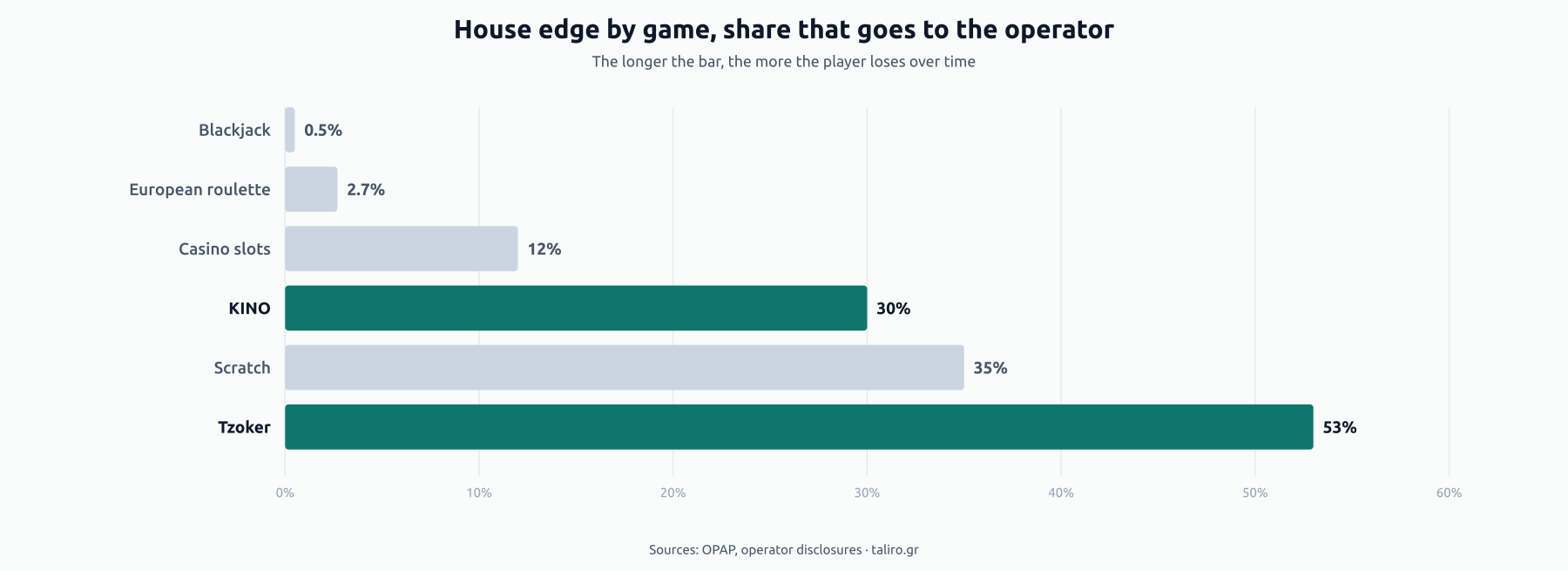
Every game has a built-in advantage for the provider. Return to Player (RTP) shows how much is returned as winnings on average.
| Game | RTP | House Edge |
|---|---|---|
| Blackjack (basic strategy) | 99.5% | 0.5% |
| European Roulette | 97.3% | 2.7% |
| Casino Slots | 88% | 12% |
| KINO | 70% | 30% |
| Scratch Tickets | 65% | 35% |
| JOKER (Tzoker) | 47% | 53% |
Practical example: How €100 disappears
A player starts with €100 and plays KINO with a bet of €5 per draw:
- KINO RTP: 70% (house edge 30%)
- Loss per game: €5 × 30% = €1.50
- Draws per hour: 12
- Expected loss/hour: 12 × €1.50 = €18
After 1 hour, the expected loss is €18. After 5-6 hours of continuous play, the €100 has mathematically disappeared.
Probability of leaving ahead
The probability of leaving ahead after one hour of play:
- Blackjack: ~49% (almost equal, but not in your favor)
- Roulette: ~43%
- Slots: ~10%
- KINO: ~19%
- JOKER: ~2.5%
The probability of being ahead after 1 year of regular play approaches 0% for all games.
Common Gambling Fallacies
Beyond the mathematical reality of house edges, players often fall victim to cognitive biases that encourage continued play.
The Gambler’s Fallacy
The gambler’s fallacy is the mistaken belief that past random events affect future outcomes. Examples include:
- “Red has come up 5 times in a row, so black is due”
- “This slot machine hasn’t paid out in hours, it’s about to hit”
- “I’ve lost 10 bets in a row, a win is coming”
The reality: Each spin, draw, or roll is statistically independent. The roulette wheel has no memory. If red came up 100 times in a row, the probability of red on the next spin remains exactly 48.6% (European roulette). The dice don’t know what happened before.
This fallacy is particularly dangerous because it can encourage “chasing losses” - betting more after losing streaks in the mistaken belief that a win is mathematically overdue.
The Bonus Edge Fallacy
Many players believe they can beat the house by strategically exploiting bonuses, free spins, welcome offers, and promotional coupons. The reasoning seems logical: “If I get €50 free when I deposit €50, I’m starting with an advantage.”
The reality: Betting companies employ teams of mathematicians to design these offers. Every bonus comes with wagering requirements (often 20-40x the bonus amount) that ensure the house edge applies over enough bets to virtually guarantee profit. Consider:
- A €50 bonus with 30x wagering requirement means you must bet €1,500 before withdrawal
- At a 5% house edge, the expected loss on €1,500 wagered is €75 - more than the bonus itself
- Free spins typically have capped winnings, low-RTP games, and wagering requirements on any wins
Professional “bonus hunters” who attempted to exploit these offers systematically have largely been eliminated through:
- Account restrictions and bans for consistent winners
- Increasingly strict wagering requirements
- Game restrictions that exclude high-RTP options
- Maximum bet limits while bonus is active
The bonuses are marketing costs, not gifts. Companies carefully calculate that bonus recipients will, on average, lose more than the bonus value.
Sports Betting: A Special Case
Unlike casino games with mathematically fixed house edges, sports betting presents a more complex picture that many bettors misunderstand.
Why the exact house edge cannot be calculated
For casino games like roulette or slots, the house edge is a mathematical certainty based on game rules. Sports betting is different:
- Outcomes depend on real-world events with countless variables
- Odds are set by bookmakers’ models attempting to predict probabilities
- Line movement responds to betting patterns and new information
- Player skill theoretically exists - some bettors may genuinely have better judgment
This complexity leads many bettors to believe they have, or can develop, a sustainable edge. Unlike a slot machine, sports betting feels like a skill game.
The harsh reality of profitability
Research consistently shows a massive gap between perceived and actual profitability:
- Studies of betting exchange data suggest 97-99% of sports bettors lose money over time
- A comprehensive UK study found that only 0.5% of accounts showed consistent long-term profit
- Research from betting platform data shows that self-assessed “winning” bettors overestimate their returns by 40-60%
- The vast majority of bettors believe they are profitable or near break-even when their actual records show significant losses
Why sustained profitability is extremely unlikely
Even if a bettor has genuine analytical skill, several factors work against them:
-
The vig (juice/margin): Bookmakers typically take 5-10% on standard bets. To break even, you need to win approximately 52.4% of even-money bets - consistently, over thousands of bets.
-
Market efficiency: Modern bookmakers use sophisticated models, employ analysts, and aggregate wisdom from sharp bettors. The odds already incorporate vast amounts of information.
-
Account restrictions: Bettors who show consistent profit patterns are routinely limited or banned. Bookmakers want losing customers.
-
Psychological biases: Selective memory (remembering wins, forgetting losses), overconfidence, and hindsight bias make honest self-assessment difficult.
-
Volume requirements: Even with a real 1-2% edge, you need thousands of bets to overcome variance - and any edge that obvious is quickly discovered and eliminated by the market.
Sports betting in Greece
Sports betting represents a significant portion of Greek gambling activity. While the precise house edge cannot be stated like a casino game, the industry’s profitability tells the story: betting companies maintain profit margins of 7-12% on sports betting revenue, indicating that as a whole, bettors systematically lose at these rates.
The exception that proves the rule: professional betting syndicates do exist, but they operate with massive bankrolls, sophisticated models, and face constant account restrictions. Their existence doesn’t mean a typical bettor can profit - it means the tiny fraction of successful bettors are professional operations, not regular punters.
Player Retention Practices
Algorithms and AI
Modern betting companies use machine learning to analyze each user’s behavior:
- Every bet, win, or loss is recorded
- Session frequency and duration are monitored
- Favorite times and games are identified
- Geographic data is utilized
Nudging at the right moment
When the algorithm detects that a player just had a losing streak or is about to disconnect:
- A personal message with a “gift” is sent
- A free bet or deposit bonus is offered
- A mobile notification appears
These offers aren’t random - they’re calculated to maximize the probability of returning to play.
Typical tactics
- Personalized bonuses: “Deposit €50 and get another €50” at the specific moment when the player is most vulnerable
- Free bets after losses: If the user lost €200, they receive 20 free spins to prevent them from leaving
- Push notifications: Alerts at match time or late at night
- VIP programs: The more you play, the higher you climb with rewards
Who Builds the Algorithms
These practices are not the work of a few IT staff. Behind the behavioural models, the perfectly-timed offers and the odds optimisation sit some of the most aggressive recruiters of quantitative talent in Greece. OPAP, now operating under the Allwyn group, and Kaizen Gaming are today among the largest employers in the country for data scientists, statisticians, mathematicians, product engineers and analytically trained marketers.
Employer recognition
- OPAP / Allwyn has been certified as a Top Employer in Greece for four consecutive years, 2023-2026, on criteria covering HR strategy, work environment, learning, wellbeing and inclusion.
- Kaizen Gaming entered the Fortune 100 Best Companies to Work For in Europe in 2024, was named Best Workplace in Tech for a third consecutive year in 2025 and Best Workplaces Hellas in 2026. It reports more than 2,800 employees across 19 countries, with about 60% of roles in tech.
What roles they hire
Both companies’ job ads make the target profile clear. OPAP/Allwyn has published openings for Senior AI Product Owner, Online Data Scientist, BI & Analytics Engineer, Data Analyst, Digital Analytics Specialist, CRM Team Leader and Head of Product & Digital Experience. One Allwyn Hellas ad for a Digital Analytics Specialist explicitly asked for a degree in Statistics, Mathematics, Computer Science, Digital Analytics or Business Analytics, plus machine learning, SQL, Python, Power BI and hands-on A/B testing and CRO experience. Kaizen, as an international GameTech firm, recruits very similar profiles for personalisation, risk detection and predictive odds optimisation.
Benefits and culture
Kaizen publishes the more detailed benefits package: private medical and life insurance for employee and family, conference budgets, unlimited access to Udemy, Pluralsight and O’Reilly, a leadership academy, postgraduate scholarships and monthly nursery coverage. OPAP/Allwyn is less explicit publicly on perks, but invests in a structured internship pipeline with Greek universities, in-house data academies and knowledge transfer through the wider Allwyn group internationally.
Why it matters
When you read that “the app pushed a free bet after a losing streak” or that “the line moved suddenly five minutes before kickoff”, the person who designed it most likely holds a degree in statistics or mathematics, and a data scientist is keeping it tuned. The sector competes for talent with banks, consultancies and global tech, and offers what quants rarely find elsewhere in Greece: consumer-scale data, a direct line between their work and revenue, and budget for experimentation. This is the other side of the house edge: on one side a player betting €5 on KINO, on the other a team of statisticians calculating with precision how much that player will lose.
Advertising Dominance
Advertising spend
In 2024, ~€94 million was spent on gambling advertising in Greece. The forecast for 2025 exceeds €100 million.
Advertising distribution
- 66% of approved campaigns are exclusively for online media
- 0.36% is for TV/radio (but TV presence remains strong)
- Almost every football team has a sponsor from the industry
Normalization of gambling
Betting has “occupied” public space:
- Over 3,500 agencies in every neighborhood
- Advertisements on trains, buses, stops
- Banners on news sites
- Sponsorships of sports teams
Young Greeks and Gambling
Kapa Research/EEEP survey data (2024)
Among young Greeks aged 17-24 who bet:
- 4 out of 10 play almost daily online
- 78% play at least weekly
- Young men are disproportionately affected
Calculate Your Own Losses
To see how much money you’re expected to lose based on the game you play, frequency, and amount wagered:
🎰 Use the Gambling Expected Loss Calculator →
The calculator is based on Monte Carlo simulations with 500,000 trials per data point and shows:
- Expected loss per visit
- Probability of leaving ahead
- Time to lose bankroll
- Projected losses over 1, 5, and 10 years
Help for Addiction
If you or someone you know is struggling with gambling:
KETHEA ALFA - Gambling Addiction Treatment: +30 210 921 5610
Key Takeaways
✅ In 2024, Greeks lost €2.879 billion to gambling, a figure that has risen steadily over the past three years
✅ Player losses correspond to ~1.2% of GDP and an average of ~€324 per adult per year, among the highest in Europe
✅ KINO has a house edge of 30% and JOKER 53%, the worst for the player
✅ Retention algorithms are designed by data scientists and statisticians that major operators (OPAP/Allwyn, Kaizen) compete hard to hire
✅ The probability of being ahead after 1 year of regular play is ~0%
✅ For every €1 the player loses, ~€0.20 becomes the company’s net profit
The information in this article is based on publicly available data from EEEP (HGC), the Bank of Greece Border Survey, OPAP/Allwyn and Kaizen Gaming filings, Kathimerini, and research reports. RTP values are estimates and may differ from actual current rates.
Sources
Last updated: 24 May 2026. This information is for general guidance and is not tax advice.